Wednesday, December 23, 2009

Political correctness is not the reason for the season


I know this is an ages-old argument, but I really feel like I need to put in my two cents about "political correctness" around the holidays.

I'm back as a cashier at Stop & Shop for Christmas break this year, and as someone who works with customers all day, I'm almost obliged to wish them some sort of goodwill for the holiday season on their way out. And it got me thinking.

As you walk around almost any store, you'll definitely notice that the words "Christmas" "Hanukkah" or "Kwanzaa" appear far less than you would think. That's because the over-indulgent consumerist honchos that own all these major companies seem to be too scared to offend anybody, and instead stick everything that everybody is celebrating at the time under one, totally impersonal umbrella greeting, "Happy Holidays".

But really, how could you get more blatantly impersonal than wishing everyone who walks by you "Happy Holidays"? That's like wishing someone a great "existence". No other phrase could more accurately depict the consumerist focus of our holiday season than "Happy Holidays". It just shows that you obviously don't give a damn what holiday someone celebrates, and you're too impersonal to offer someone any insight as to what exactly you celebrate at this time of the year.

I don't celebrate "Holiday". "Holiday" to me means some sort of time off from work--a break or a vacation. While this may be true, it completely disregards the meaning of the season and why exactly I celebrate Christmas. Christmas to me is not just time off from school--it's a time to see family I don't see very often, a time to give presents to show our appreciation for each other, a time of remembering past traditions, and most importantly, a time to celebrate one of the most important events in human history--the birth of Jesus Christ. Calling all of this just a "holiday" seems a bit unfair right?

I would rather wish someone a "Merry Christmas" and have them correct me, saying for instance that they're Jewish and celebrate Hanukkah. Because at least at that point you've gained some deeper knowledge of the person and had a somewhat meaningful discourse rather than just some words that you throw at them on the way out the door that have little meaning for either you or them.

And most importantly, by saying "Merry Christmas" or "Happy Hanukah" or "Happy Kwanzaa" you have revealed something deeper about yourself--that you are a Christian and celebrate Christmas, or you are Jewish and celebrate Hanukah, or you are African and celebrate Kwanzaa. It shows that you understand that there is some deeper meaning of the time of the year other than just buying stuff for people. I believe that Christmas, Hanukah, and Kwanzaa share a similar spirit--that of being personal with those around you. Cheap, meaningless phrases like "Happy Holidays" do not adhere to the deeper meaning of any of these three celebrations, and the umbrella term of "Happy Holidays" just shows that this time of year means nothing more than the commercialism surrounding it.

Friday, December 18, 2009

Been a long time--AVATAR review

Okay guys, I'm super sorry for not updating my blog since September--the school year's been pretty crazy and I just never really got around to it. So I figured that now that Christmas break has started, I can kick things back into gear with a good ole movie review of a movie I saw at midnight last night. Ladies and gentlemen: my review of James Cameron's AVATAR.


First, a clarification: this movie is NOT...I repeat NOT based on the Nickelodeon cartoon of the same name. There is in fact a movie coming next year out based on the Nickelodeon cartoon entitled The Last Airbender. But this is entirely different. The original script for this movie was written all the way back in 1994 by writer/director James Cameron, only a few years after his smash hit and action movie revolution film Terminator 2 and only a few years before he created the current box-office record holder Titanic. However, Cameron decided to wait on actually making Avatar, as the budget would have been more than he could afford at the time and he felt that the CGI technology necessary to do the script justice just wasn't there yet. But a couple of years ago, Cameron felt that the time was finally right to make his masterpiece. Using some of the most advanced CGI and 3-D technology seen yet (more on that later), revolutionary filming techniques, and a budget of over $300 million, Cameron has finally brought his dream project to life. So just how good is it?

The answer: simply amazing.

I don't even know where to begin, but I guess I can start talking about the plot. It is certainly a very complex plot that I won't spoil for you, but just to give you the gist of it, Avatar takes place in the year 2154 on the fictional forest planet of Pandora, where an alien race (the Navi) reside. However, humans from the outside world are deeply interested in accessing some sort of extremely valuable mineral located under Pandora's surface, and the Navi living right on top of the largest deposit of the mineral on the entire planet. Using a breakthrough scientific technology, humans have begun creating "Avatars", which are bodies made up of a mix of human and Navi DNA. They have developed a technology that allows humans to actually shift their consciousness into these Avatars, allowing them to live inside these bodies and more easily interact with the natives. The story follows Jake Sully (Sam Worthington), an ex-U.S. Marine, who is assigned to become one of these Avatars and go into the dense forests of Pandora in order to discover what it will take to get the natives to relocate so the humans can access the mineral deposit. However, not everyone agrees with the science community's diplomatic policy: the Military, led by Colonel Miles Quaritch (Stephen Lang), is all in favor of simply wiping out the Navi in order to gain access to the deposit. Without giving too much away, Jake Sully, as an Avatar, is in a race against time to fulfill his mission for the humans, but on the way discovers new things about the Navi, the forests of Pandora, and himself.

It really is an incredible story and is done extremely remarkably. It has close ties to stories we've all heard before, including everything from Pocahontas to the U.S.'s westward expansion to the Iraq War. And it's really one of the only thing that you can fault this movie for: the simple fact that we have heard this story a million times before and it is fairly predictable. But it's really hard to not like the movie because of this fact, as the story is so incredibly timeless and relevant to us today. Though the movie has an obvious bias, it never feels like it gets too preachy, and it really does hold your interest the whole way through, even if you can probably guess what is going to happen.

Now let's talk about visuals. This certainly isn't a movie that you can just brush off the visuals on; the visuals are a MAJOR component of the movie. It's so easy to see why such an incredibly high budget was needed to make this movie. The CGI (Computer Generated Imagery) is easily the most advanced seen in a movie yet. The entirely CGI jungles of Pandora are so incredibly lush and lifelike you'd swear it was a real place (that is, perhaps until you witness the awe that is Pandora's floating mountain range). But where the movie really makes HUGE leaps is with the entirely CGI Navi and Avatar characters. The creatures are so lifelike, their expressions so accurately portraying every last drop of human emotion, that it's hard not to think that these creatures really exist. The way they move and act doesn't look so obviously fake like the billions and billions of other CGI creatures out there. This is the leap that CGI in movies has so desperately needed since it began being used in the mid-90s. We're going to look back and laugh at the so obviously fake CGI that existed prior to this movie. It's really no surprise that such a leap came from James Cameron--after all, the T-1000's morphing ability in Terminator 2 was one of the first major examples of CGI used in movies.

And after seeing Avatar in 3-D, I'm totally convinced that it's the ONLY way to truly experience this film. As one of the first feature films to be fully FILMED in 3-D using special cameras that actually capture depth, it really really delivers. This definitely isn't the gimmicky 3-D where it's blatantly obvious that many shots were catered to making you go "woah!" when you see it in 3-D. Cameron just tells the film the way it should be told, and uses the 3-D effect to greatly enhance it. It really makes it feel more like you're looking out a window into the vast Pandora forest rather than simply viewing it on a flat movie screen. The depth provided by the 3-D is simply stunning. The movie really comes alive in 3-D, and working together with the incredible CGI effects, really transports you into the world of Pandora. I honestly think I would be really disappointed viewing the movie in normal 2-D now that I've seen all three dimensions of it.

The acting is all top notch too. Worthington's character is a really likable guy, and you can really see and entirely understand the conflict he's going through. The villain is also someone that you really really hate by the end of the movie. All of the other actors, including the voice acting and motion capture work done for the Avatars and Navi, is all absolutely top notch.

Overall, Avatar really is a spectacular movie. I really feel like this movie is very comparable to Cameron's original Terminator: a plot that isn't entirely original, yet it just works so well because of the incredible new take on it, combined with some fantastic visual effects. Cameron has already stated that he plans on making sequels if the movie does well in the box office, and it's really one of those movies that I would be totally okay with there being a sequel for. If Cameron DOES make a sequel, I really hopes he does what he did with Terminator 2 and create a sequel that combines an entirely original concept to all of the amazing things done in the first movie to create a movie that will be the standard to which every other movie in the genre is held up to. But for now we have Avatar, which is an absolutely incredible movie in it's own right that may not completely change the way in which movies are written, but will most certainly change the way in which they are presented.

I give it 4.5/5 stars.

Wednesday, September 2, 2009

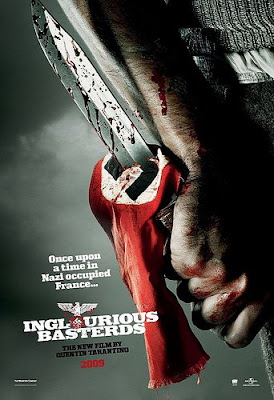
Movie Review: Inglorious Bastards


So tonight me and my friends decided to go see a movie.  We were tossed up between two movies:  Inglorious Bastards, which I hadn't seen yet, and District 9, which judging from my review, I really liked.  We decided on Inglorious Bastards.  Let's just say I wish I saw District 9 again.

Inglorious Bastards is definitely not a bad movie in the traditional sense of a bad movie.  The characters are interesting, the actors are great, and the idea definitely has solid background.  But the style of the movie and scenes are just so all over the place that what could've been a great idea is just made into a boring mess of a movie.  

By far the biggest problem with this movie is that it has a SEVERE case of identity crisis.  Before I walked into the theater, I was expecting a comedy.  I sat down expecting to laugh, and was completely thrown off by the horribly tragic first scene, in which a tiny little farmhouse in Nazi-occupied France is visited by Nazi officers because of suspicions of a family of Jews hiding out there.  It's not that the scene isn't well done--the dialogue and acting are all spot on, and it's actually builds up quite a lot of tension.  It's just the furthest thing from funny; not in one of those "all the jokes are falling flat" type of way, but because this scene is supposed to be completely serious.  Then the next scene takes us to Brad Pitt making a bunch of dumb jokes as Lt. Aldo Raine, who is leading a group of vigilante American officers in France who are out to kill and scalp the Nazis.  Then it goes back to a more serious drama about one of the girls who escaped the Nazi attack in the first scene and is trying to rebuild her life as a French citizen.  The movie just can't decide what it wants to be.  There are way too many scenes when I was trying to figure out if I should be laughing or not.  Some scenes are dead serious, some are totally comedic, and some are a poor hybrid of both.  I just didn't know what to make of it.

"Inglorious Bastards" is kind of a misleading title, because we only actually see the Inglorious Bastards and their associates for less than half the movie.  There are two major plot lines that run throughout the movie and meet at the end.  The first is about Lt. Raine and his group of Inglorious Bastards bent on the killing and scalping of Nazis.  The other is a drama about the girl who escaped in the first scene, who has just been put in charge of premiering a new Nazi propaganda film at her cinema.  But this isn't one of those movies that cuts back and forth between the two story lines.  Instead, it gives us these two stories in huge chunks.  It'll spend a half hour or so on one story, then a half hour or so on the other, and it goes back and forth until they eventually meet at the end.  However, the movie focuses so much on one story that you almost completely forget that the other even exists until it comes back to it again.  Also, both stories are filled with so many ridiculously boring dialogue scenes that just feel completely unnecessary or dragged out far beyond what they need to be.  And like I said, it's not that the characters aren't interesting, it's just that there are so many scenes that just feel so unneeded.  

However, the final scene (the last 20 or so minutes of the film) is so wonderfully paced and plotted that you almost forget about the messy bore that was the rest of the movie.  ALMOST.  The last scene really leaves you wishing that the entire movie was like this.  Unlike the rest of the movie, the last scene is great at mixing both humor, seriousness, and suspense.  I almost wish that I had just walked into the movie at the beginning of this scene--I would've liked the movie much more.  As it stands though, a great ending cannot make up for the fact that the rest of the movie was so poorly paced and edited.

In the end, Inglorious Bastards is a two and a half hour mishmash of a movie that easily could've been condensed into an hour and a half or shorter movie that was either a comedy or a serious drama loosely based on historical events.  You just can't go from scenes showing Nazis graphically butchering Jews to Brad Pitt acting like an idiot.  It's a shame too, because the very interesting characters and great acting in the movie had so much potential.

I give it 2/5 stars.

And if you want to see a good movie about the events of World War II that can blend humor and seriousness, look no further than the 1997 movie "Life Is Beautiful". 

Friday, August 14, 2009

Movie Review: District 9


District 9 is for us today what movies such as "Invasion of the Body Snatchers" and "The Day the Earth Stood Still" were for the 1950s.  Like those movies, "District 9" unquestionably a social commentary, and it does a fantastic job of driving the point home and giving us a great movie experience at the same time.

The movie feels like it's really divided into two parts.  The first half is done in an extremely convincing mockumentary style.  While many other movies in the science fiction genre may have done something like this, not too many have really dedicated this much time to it. *Minor spoilers--but nothing not shown in the trailer*  The mockumentary explains how, in the early 1980s, an alien mothership from an unknown planet came to a stop over a South African city.  Humans waited for months for the alien invasion to occur, but nothing happened.  Finally they decided to break into the mothership, and what they found were tons of freezing, starving aliens.  The aliens were taken and put into an internment camp (District 9--basically an alien slum) where they were treated very poorly and hated by humans.  The company Multi-National United (MNU) was put in charge of the aliens.  The mockumentary follows MNU field operative Wikus van der Merwe, almost thirty years after the aliens first arrived, as he attempts to get the aliens in the internment camp to sign an eviction notice in attempts to move them to another camp away from the city population, District 10.  While on this mission, he discovers an alien chemical tube which he accidentally sprays himself with.  The contents of the tube...well you're just going to have to see the movie to find out...

The documentary-style film done in the first half of the movie is extremely convincing, with nice shaky amateur camera work from the cameraman following van der Merwe, and other visual sources (including security cameras and home movies).  They also include numerous interviews with different people involved with the alien internment, which really brings the documentary to life.  It's all very convincing, and doesn't make the alien internment seem far fetched at all.  The social commentary about real life slums and the treatment of people in them is always clear without being too over-the-top.  The acting is all top notch, even if all of the actors are relatively unknown.  The entirely CGI aliens are also very believable, and the movie does a good job of making them feel almost human.  On a side note, Star Wars fans like myself will be quick to notice the erie similarities between the alien race from District 9 and the Geonosian race from Star Wars Episodes II and III, not only in the way they look, but also in their language and speech (Coincidence?  Or is George Lucas pulling strings around the science fiction genre?  You be the judge). 

The movie takes a sharp and fairly unexpected turn towards the second half, from sci-fi mockumentary to sci-fi action movie.  I was admittedly very nervous when I realized that the movie was going in this direction, as this could have easily completely ruined the awesome setup of the first half of the film.  Luckily, I was not in the least disappointed.  I can't say too much about it without some major plot spoilers, but I will say that the action is absolutely top notch and always intense.  These are action scenes that make you sit up and pay attention, not lean back and sleep.  It is also perfectly paced, as not one action scene drags on so long that it gets boring, unlike the CGI noisefest from earlier in the summer that was Transformers: Revenge of the Fallen.  I wouldn't believe I would be making this comparison before I saw the movie, but I actually think that District 9 succeeds more as an action movie than Transformers, and District 9 has so much more going for it outside of the action.

This is one of those movies that's really hard to say a lot about without spoiling the plot, which is probably the main reason why I found that most people really had no idea what the movie was about before walking into the theater.  But believe me when I say that this movie has all the makings of a true science fiction classic--social commentary, almost believable plot and characters, and an intense, somewhat disturbing ride the entire way through.  This is unquestionably one of the best, if not THE best movie of the summer, and something that is well worth the price of admission for anyone above 17.  It's thought provoking and mildly disturbing in all the right ways, and delivers a solid action movie on top of all of that.  

I give this 5/5 stars.

Wednesday, July 22, 2009

Support your local video store!

In the days of ON DEMAND movie rentals, video rental stores seem to have become a thing of the past for a lot of people.  Video rental stores are really hurting with new things like Netflix and ON DEMAND.  I see less and less video stores in my city all the time (only a few years ago there were 4 or 5, and now there is only one).  The point is, video rental stores are dying, and we have to make sure they stay in business.  The selection offered by video rental stores is above and beyond anything ON DEMAND has to offer, especially when you're looking for older movies.  Plus, you get the DVD with special features and can keep the movie longer.  The price is usually about the same too, and most video stores now offer movies both in standard definition and in blu-ray.  And where do all those copies of new movies go when they're not new releases anymore?  They get sold to us a rock bottom prices at the store!  You can't get that anywhere else.  The point is, next time you're about to click "buy now" to rent a movie on your TV, think about how much you already pay to your cable/satellite provider, and consider driving a couple minutes in your car to support a dying industry instead.  

Sunday, July 19, 2009

The "Freedom of Choice" Act


Personal freedom and liberty has always been the backbone of what makes America so great.  Patrick Henry's famous words "Give me liberty, or give me death!" are a testament to just how important personal freedom is to Americans.  But exactly how much are we willing to sacrifice for the personal freedom to choose?  

Enter the Freedom of Choice Act, a bill first considered in 1989, newly revised and being considered by many state Congresses across the country, including the Rhode Island Congress.  The Freedom of Choice Act would lift pretty much all state and federal restrictions on abortion, including:

- State abortion reporting requirements in all 50 states 
- Forty-four states’ laws concerning parental involvement 
- Forty states’ laws on restricting later-term abortions 
- Forty-six states’ conscience protection laws for individual health care providers 
- Twenty-seven states’ conscience protection laws for institutions 
- Thirty-eight states’ bans on partial-birth abortions 
- Thirty-three states’ laws on requiring counseling before an abortion 
- Sixteen states’ laws concerning ultrasounds before an abortion 


And one bill is going to overturn all of those laws.  Think about what's going on here.  I know the freedom to choose is incredibly important, but is the freedom to choose really worth so many innocent human lives that don't even have a say in it? 

There are so many laws in this country protecting the freedom of life.  There's laws against homicide, abuse, suicide,  etc.  So why are there no laws protecting human life inside the womb?  How is it that a human life inside the womb is worth less than a human life outside the womb?  Many would argue that a fetus inside the womb isn't technically a life at all.  Science seems to think otherwise:

"There is no more pivotal moment in the subsequent growth and development of a human being than when 23 chromosomes of the father join with 23 chromosomes of the mother to form a unique, 46-chromosomed individual, with a gender, who had previously simply not existed."--Dr. Fritz Baumgartner, MD.

Going by this definition of life, it is hypocritical to think that the government should be able to protect life outside the womb, but not be able to interfere with life inside the womb.  How is it worse if a mother kills her child still in the womb versus killing her child while outside the womb?

May argue that a woman should be in charge of her own body.  That's all well and good, but if the thing inside of her is truly another life, than it is no longer her body is it?  Many argue that it's a matter of viability.  Viability is defined as:

"having reached such a stage of development as to be capable of living, under normal conditions, outside the uterus."

A child inside the uterus is completely dependent on the mother for its life.  I get that.  But what's the difference once the child is born?  If you give birth to a child and just leave it somewhere and ignore it, it will still die.  It is still just as "viable" and dependent on the mother as it was when it was inside her.  

And the Freedom of Choice Act would lift so many bans on partial birth abortion.  There are a few ways to perform partial birth abortion, but one common way involves turning a child around inside the mother so it is born feet first.  Because the child is still technically unborn when its head is still inside its mother, they can give birth to the baby up to its neck, and then insert a knife into the back of the baby's skull in order to severe its brain stem and quickly kill it.  The practice is disgusting and barbaric and should not be allowed in a country that holds the right to life so sacred.  But then again, if pregnancy termination is allowed during earlier stages when the fetus (still a life with its entire genetic makeup) what's the difference if it's allowed to be terminated at any stage?  

The Freedom of Choice Act also lifts laws requiring counseling before an abortion.  A decision as big as abortion should not be made alone, and the ability to just walk into a clinic without first talking to anyone about it and considering alternatives is definitely not the right way to go.  In this way, rash decisions that will likely be regretted later will be made.  


I know that was more of a rant against abortion in general, but since this bill pretty much attacks all laws regarding it, there's really no other way to address it.  Feel free to post your opinions on the topic.

Thursday, July 16, 2009

"Holy Matrimony"


A couple of weeks ago, I wrote an article about my feelings on the legalization of same sex marriage from a very secular perspective.  Now I'm going to look at marriage from a much less political perspective.  I just finished reading an article by Diocese of Providence Bishop Thomas J. Tobin.  In this article, he takes a look at how religious marriages are viewed by our modern secular society.  The article can be found here (the rest of this is just going to be my thoughts on the article, so I would read it if I were you):

http://thericatholic.com/news/detail.html?sub_id=2350

I really think that Bishop Tobin brings up some fantastic points about marriage today.  Marriage today is a hollow shell of what it was intended to be.  Instead of marriage being the start of a fully committed bond between two people, marriage is just seen as an ages-old ceremony that you go through with the person you probably want to live with and have sex with for a long period of time.  "Till death do us part" has little to no meaning anymore as the divorce rate in the country, even among religious marriages, is in the 50% ballpark.  People do not see marriage for what it truly is: an undying commitment to your spouse, with an emphasis on commitment.  It's not a business deal, and it's not a sex permit.  It's a commitment that you make to someone in which you promise that you'll always be looking out for nothing but the best for them for the rest of your days.  It's a promise that you will help them live out their lives to be the best that they can be.  Just as priests take a vocation to their Church, a bride or groom takes a vocation to their spouse.  

The first, and I think biggest problem that the Bishop proposes is the fact that a huge number of couples live together and have sexual relations before marriage.  This already shows a complete misunderstanding of the marriage vow.  I'm sure that somewhere down the line, I'm going to write an article about my views on sex, but for now, I will say that in order to understand the commitment made in marriage, one has to understand that sex is something that should only be done within the boundaries of a commitment as strong as Holy Matrimony. Without the understanding of that, Matrimony has already lost most of its meaning.

The bulk of this article seems to focus on how marriages today on trying to be the Princess's enchanted wedding to Prince Charming.  It's a ritual that has lost most of its meaning.  It's all about how the wedding looks, and not at all about what it means.  There are so many Catholics out there who make their Confirmation simply because they "want to get married in a Church".  If that's all you care about in your marriage, than why even bother?  Weddings are so full of things that "have to be done".  Why does the bride always have to throw the bouquet?  Why do the bride and groom HAVE to feed each other with their hands and look like idiots?  While I'd argue that these are not bad things in and of themselves, they certainly prevent the wedding to be anything but going through the motions.  

One minor thing I will have to disagree with the Bishop on is his paragraph about how he feels that Catholics should only look to Catholics to date.  While Catholic to Catholic dating is certainly ideal, I do not feel like it is always necessary.  There are great people that can have beliefs that differ from your own.  What I believe is important in inter-faith dating/marriage is your ability to accept each other, and to never give up your beliefs just for the other person.  A strong commitment to God is always more important than pressure put on you by the person that you're dating or are married to.  I understand how having the same faith makes marital decisions much easier, but I think that a person who is committed enough to their faith and an understanding spouse will be able to overcome these obstacles and live out these vocations.

That's all I have to say for now.  Let me know what you think!